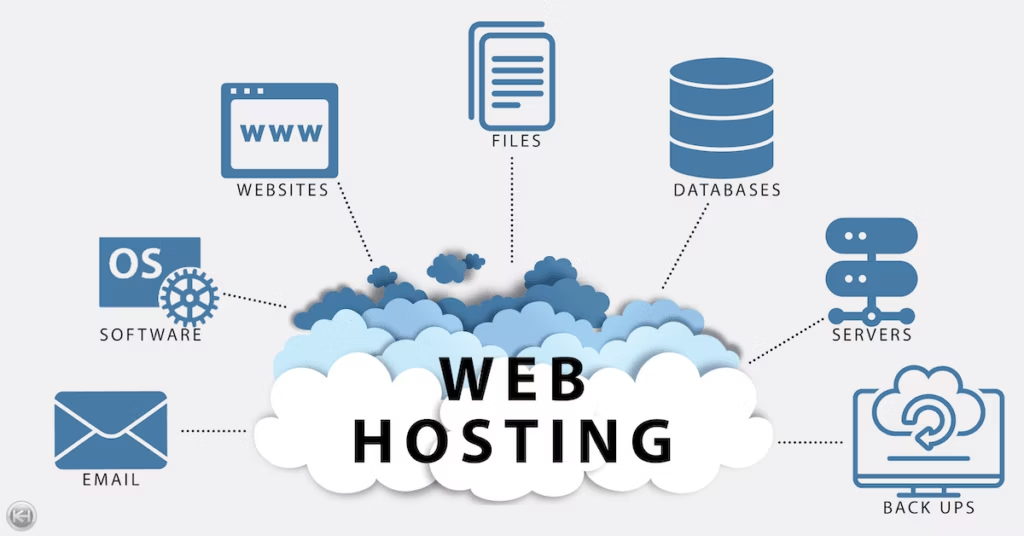
47% of Users Abandon Sites Loading Over 2 Seconds—Yet Most Businesses Pick Hosting Plans That Guarantee Failure
Your website loads slowly. Customers leave. Sales vanish. Your Google rankings drop. Competition captures market share. And you blame “traffic” or “market conditions” while the real problem sits in your server—the web hosting plan you chose because it was cheap, convenient, or recommended by someone who didn’t understand the stakes.
Web hosting determines whether your website performs or fails—yet most Toronto businesses select hosting plans the way they’d pick restaurants: based on price, reviews from strangers, or whatever their cousin’s friend recommended. This casual approach to infrastructure decisions costs businesses staggering amounts in lost revenue, destroyed SEO rankings, and competitive disadvantage.
The global web hosting market reached $126.4 billion in 2024, projected to hit $372.31 billion by 2030 (13.62% CAGR). This explosive growth isn’t driven by businesses treating hosting as commodity expense—it’s driven by businesses recognizing that hosting infrastructure directly determines digital success or failure.
Downtime costs large organizations an average of $9,000 per minute. Small businesses lose $137 to $427 per minute during outages. 88% of consumers won’t return to websites after experiencing downtime. 47% of users expect websites to load in 2 seconds or less—and abandon slower sites immediately.
These aren’t technical metrics—they’re revenue killers. Every second your site loads slowly, every minute it’s offline, every visitor who bounces because your server responded too slowly—all represent direct revenue loss caused by inadequate hosting infrastructure.
The difference between thriving online businesses and struggling competitors often isn’t product, price, or marketing—it’s hosting infrastructure that either enables success or guarantees failure.
For Toronto businesses investing in professional web development and digital marketing, hosting decisions determine whether that investment delivers ROI or gets wasted on infrastructure that can’t perform.
Understanding Web Hosting: What Actually Matters in 2026
There are approximately 1.119 billion websites on the internet, with 330,000+ web hosting companies competing for business. This overwhelming choice paralyzes decision-making—most businesses either pick the cheapest option or stick with whatever hosting their web developer set up years ago.
The Types of Hosting and Their Real-World Impact
Shared Hosting: Your website shares server resources with dozens or hundreds of other websites. Shared hosting holds 37.64% of the global market and is expected to generate $70.6 billion by 2026. It’s popular because it’s affordable—but affordability means nothing if performance suffers.
Reality: When neighboring websites experience traffic spikes, your site slows down. You have zero control over resource allocation. Security vulnerabilities in other sites on your server can affect you. For low-traffic brochure websites, shared hosting works. For businesses depending on website performance for revenue, it’s inadequate.
VPS (Virtual Private Server) Hosting: Dedicated resources within shared physical server. VPS hosting accounts for 10.3% of the market and is projected to reach $8.3 billion by 2026. Offers better performance and control than shared hosting without dedicated server costs.
Reality: VPS provides guaranteed resources, better security isolation, scalability options. Ideal for growing businesses that have outgrown shared hosting but don’t need dedicated servers. Requires more technical expertise to manage unless you choose managed VPS.
Cloud Hosting: Resources distributed across network of servers enabling seamless scaling. Cloud computing market reached $1,125.9 billion in 2024, expected to hit $2,281.1 billion by 2030 (12% CAGR). AWS, Microsoft Azure, and Google Cloud control 63% of global cloud infrastructure market.
Reality: Cloud hosting provides reliability through redundancy—if one server fails, others compensate. Scales automatically during traffic surges. Pay-for-usage model eliminates over-provisioning. The fastest-growing hosting segment for good reason.
Dedicated Hosting: Entire physical server dedicated exclusively to your website. Holds 27.9% of web hosting market, valued at $16.95 billion in 2023, projected to reach $56.96 billion by 2030. About 10 times more expensive than shared hosting.
Reality: Maximum performance, complete control, highest security. Necessary for high-traffic websites, complex applications, or businesses with strict compliance requirements. Overkill for most small to medium businesses.
When developing comprehensive website strategy and infrastructure, hosting type determines performance ceiling and scalability potential.
The Real Cost of Wrong Hosting Decisions
Most businesses drastically underestimate hosting’s impact on revenue—treating it as IT expense rather than revenue infrastructure. The real costs compound in ways balance sheets never capture:
Performance Costs That Destroy Revenue
47% of users expect sites to load in 2 seconds or less—every additional second of load time hemorrhages potential customers. 1-second page load delay causes 11% loss in page views. 2-second delay increases bounce rates by 103%.
For e-commerce site generating $100,000 monthly revenue, 1-second load delay from inadequate hosting costs $11,000 monthly ($132,000 annually) in lost sales. That’s conservative—reality is often worse.
7% conversion rate decrease per 1-second delay means slower hosting directly reduces revenue even when traffic remains constant. Spending $500/month on proper hosting that eliminates 2-second delays generates $22,000+ monthly revenue increase through recovered conversions alone.
Downtime Costs That Accumulate Silently
99.9% uptime guarantee sounds impressive—until you calculate it means 8 hours 45 minutes of downtime yearly. For business generating $500,000 annually, that’s potentially $5,000+ in lost revenue during guaranteed downtime periods.
99.99% uptime (52 minutes yearly downtime) vs 99.9% uptime (8.75 hours yearly) represents $4,500+ annual revenue difference for that same business—often for minimal monthly hosting cost increase.
54% of significant data center outages are caused by power failures—choosing hosting providers without robust backup power infrastructure guarantees eventual catastrophic downtime.
60% of Fortune 500 companies experience minimum 1.6 hours downtime weekly—even enterprise infrastructure fails without proper redundancy and monitoring.
SEO Penalties That Compound Over Time
Google prioritizes fast-loading websites. Slow hosting doesn’t just lose visitors—it systematically destroys search rankings over months and years.
Site speed is core ranking factor: slower sites rank progressively lower as Google favors faster competitors. Traffic declines aren’t sudden—they erode gradually as rankings slip, making causation difficult to identify.
Mobile performance especially critical: with mobile-first indexing, slow mobile site performance (often caused by inadequate hosting) damages rankings across all devices.
Uptime reliability affects crawl budget: frequent downtime means Google’s crawlers encounter your site offline, reducing crawl frequency and index freshness. Your latest content doesn’t rank because Google hasn’t crawled it yet.
When implementing SEO strategy and content marketing, hosting infrastructure determines whether optimization efforts succeed or get sabotaged by technical performance issues.
How to Actually Evaluate Hosting Plans in 2026
Most businesses evaluate hosting based on price and feature lists—completely ignoring factors that actually determine success or failure. Here’s what matters:
1. Server Location and Content Delivery
Server physical location dramatically impacts load times. User 3,000 km from your server experiences significantly slower load times than user 100 km away.
34.2% of servers globally are located in United States—but if your Toronto customers visit from Canada, hosting on Canadian servers or using CDN (Content Delivery Network) dramatically improves performance.
Cloud hosting with global server distribution eliminates geography as bottleneck. Your content gets served from servers physically closest to users regardless of location.
2. Resource Allocation and Scalability
Traffic fluctuates: seasonal businesses experience 10x traffic variations. Product launches spike traffic unpredictably. Viral marketing success should be celebrated—not cause website crashes.
Shared hosting can’t handle traffic surges—resources are fixed and shared. Your site crashes exactly when success demands it perform.
Cloud and VPS hosting scale automatically or allow rapid manual scaling. Success doesn’t become disaster because infrastructure can’t adapt.
3. Uptime Guarantees (And How to Verify Them)
“99.9% uptime guarantee” means different things to different providers. Some exclude scheduled maintenance. Some calculate monthly. Some offer refunds only if you prove downtime exceeded limits.
Verify independently: use uptime monitoring services to track actual performance vs. promised SLAs. Historical uptime data reveals truth behind marketing claims.
Understand refund terms: some “guarantees” refund only hosting fees—providing zero compensation for actual revenue lost during downtime.
4. Technical Support Quality and Availability
When your website crashes at 2 AM, technical support quality determines recovery time—and every minute costs revenue.
24/7 phone support with technical expertise differs dramatically from “submit ticket and wait 24-48 hours for response.” Evaluate:
- Average response time for critical issues
- Technical competence of support staff
- Support availability (24/7 vs business hours)
- Communication channels (phone, chat, ticket)
Managed hosting includes proactive monitoring and maintenance—problems get fixed before customers encounter them rather than after you notice revenue dropped.
5. Security Features and Backup Systems
68% of businesses report challenges staying compliant with data privacy regulations—hosting security determines whether you meet requirements or face penalties.
Essential security features:
- SSL/TLS certificates (now standard across 88% of websites)
- DDoS protection
- Malware scanning and removal
- Web Application Firewall (WAF)
- Regular security updates
Backup systems determine recovery from catastrophe: daily automated backups with easy restoration capabilities vs. no backups means difference between quick recovery and permanent data loss.
6. Technology Stack and Performance Optimization
Server technology impacts performance: PHP version, database optimization, caching systems, HTTP/2 vs HTTP/1.1 support, SSD vs HDD storage.
Modern hosting leverages:
- LiteSpeed or NGINX for faster server response
- Built-in caching (Redis, Memcached, Varnish)
- Image optimization and compression
- HTTP/3 and QUIC protocol support
- CDN integration
Outdated server technology guarantees slower performance regardless of bandwidth and resources.
When partnering with agencies offering website development and performance optimization, hosting infrastructure either enables or limits optimization potential.
The Cloud Hosting Revolution: Why It Matters for Toronto Businesses
80% of enterprises are shutting down traditional data centers by 2025 and migrating to cloud infrastructure. This massive shift isn’t driven by technology trends—it’s driven by cloud hosting’s measurable business advantages.
Why Cloud Hosting Dominates
Reliability through redundancy: traditional hosting means single server failure causes complete downtime. Cloud hosting distributes across server network—failures affect individual servers without taking down entire site.
Automatic scaling: traffic spike? Cloud infrastructure automatically allocates additional resources. No more crashed websites during successful marketing campaigns.
Geographic distribution: serve content from servers globally positioned closest to users. Toronto business with international customers delivers fast loading times everywhere, not just locally.
Pay for what you use: traditional hosting requires paying for maximum capacity even during low-traffic periods. Cloud hosting scales resources (and costs) with actual demand.
The Big Three Cloud Providers
AWS (Amazon Web Services) leads with 30% cloud infrastructure market share, powering 4.8% of all websites globally. Dominant choice for enterprises and scaling startups.
Microsoft Azure holds 20-23% market share and leads enterprise adoption with 81% of organizations using its services. 95% of Fortune 500 companies use Azure for at least some business needs.
Google Cloud captures 12-13% market share, strong in analytics, machine learning, and businesses already using Google Workspace.
Combined, these three control 63-68% of global cloud infrastructure market—dominance built on reliability, global reach, and continuous innovation.
Multi-Cloud Strategy
86% of organizations use multi-cloud strategy deploying services across multiple providers. This approach:
- Avoids vendor lock-in
- Improves resilience (one provider outage doesn’t kill everything)
- Enables geographic optimization
- Leverages provider-specific strengths
70% of enterprises use hybrid cloud combining public cloud with private infrastructure for optimal balance of scalability, control, and security.
Your Toronto Business Hosting Selection Framework
Immediate Assessment (This Week)
- Audit current hosting performance: Run speed tests (GTmetrix, PageSpeed Insights), monitor uptime, review server resources usage
- Calculate actual downtime costs: Estimate hourly revenue, multiply by potential downtime hours
- Analyze traffic patterns: Review analytics for traffic trends, peak periods, seasonal variations
- Identify performance bottlenecks: Determine if current issues stem from hosting limitations or other factors
- Review current hosting costs: Compare against business value delivered
Selection Criteria (Based on Your Business)
For small local businesses (brochure sites, low traffic):
- Quality shared hosting or entry-level VPS sufficient
- Priority: reliability and local support over maximum performance
- Budget: $10-50/month
- Recommended: Managed WordPress hosting from reputable provider
For growing businesses (e-commerce, regular traffic, lead generation):
- VPS or cloud hosting necessary
- Priority: scalability, uptime guarantees, performance optimization
- Budget: $50-200/month
- Recommended: Managed cloud hosting (Cloudways, Kinsta, WP Engine)
For established businesses (high traffic, complex applications, business-critical):
- Cloud hosting or dedicated servers essential
- Priority: maximum uptime, performance, security, support
- Budget: $200-1000+/month
- Recommended: AWS/Azure/Google Cloud with managed service layer
Migration Planning
Migrating hosting is complex—poor execution causes downtime, data loss, SEO damage, broken functionality. Professional migration includes:
- Complete backup of current site and databases
- DNS transition planning to minimize downtime
- Testing on new server before making live
- Staged migration for complex sites
- Post-migration monitoring and optimization
When implementing website migration and hosting optimization, professional execution prevents costly mistakes.
Common Hosting Mistakes Toronto Businesses Must Avoid
Mistake 1: Choosing Based Only on Price
Cheapest hosting guarantees inadequate performance. $5/month shared hosting costs less than single hour of downtime for most businesses. Saving $20/month on hosting while losing thousands in revenue is insane economics.
Mistake 2: Never Upgrading
Your business grows but hosting doesn’t. Website launched 5 years ago on shared hosting now experiences 10x traffic—but still runs on same infrastructure. Guaranteed performance problems.
Mistake 3: Ignoring Load Times
“Website seems fine to me” while actual users experience 5-second load times because you test on fast connection and cached browser. Real users abandon before pages load.
Mistake 4: No Performance Monitoring
You don’t know site’s down until customers complain—or worse, they don’t complain and just buy elsewhere. Uptime monitoring alerts you to problems before revenue impact.
Mistake 5: Trusting Web Developer’s Default Choice
Developer picked whatever hosting they’re familiar with—not necessarily what’s optimal for your business needs, budget, and growth trajectory.
Hosting Decisions Determine Digital Success
The global web hosting market grows from $126.4 billion to $372.31 billion by 2030 because businesses recognize hosting infrastructure directly determines online success or failure.
Downtime costs $9,000 per minute for large organizations and $137-427 per minute for small businesses. 47% of users abandon sites loading over 2 seconds. 88% won’t return after experiencing downtime. These aren’t technical metrics—they’re revenue killers.
The difference between businesses dominating online markets and competitors struggling isn’t better products or bigger marketing budgets—it’s infrastructure that enables success rather than sabotaging it.
Your hosting choice determines:
- Whether customers wait for slow pages or bounce immediately
- Whether traffic surges become revenue or cause crashes
- Whether SEO optimization succeeds or gets killed by performance issues
- Whether you capture market share or lose it to faster competitors
Most Toronto businesses choose hosting casually—based on price, convenience, or outdated recommendations—then wonder why their website underperforms. Smart businesses recognize hosting as revenue infrastructure and invest accordingly.
The question isn’t whether to invest in proper hosting—it’s whether you can afford not to while competitors capture market share you’re losing to inadequate infrastructure.
Ready to stop losing revenue to hosting problems? Partner with experts who understand web hosting optimization, performance infrastructure, and strategic technology decisions that enable business growth rather than limiting it.
To visit our social media, please click on Facebook and Instagram