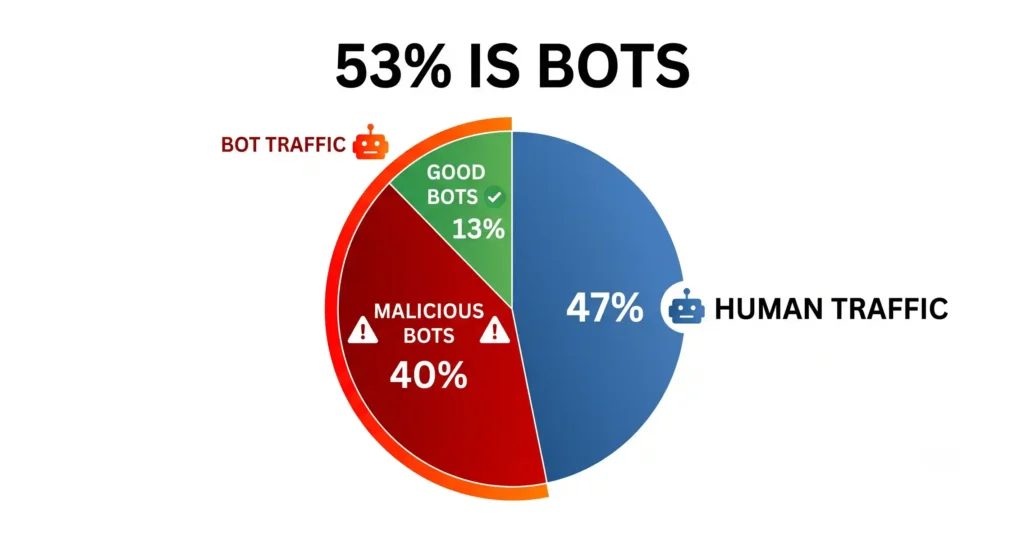
Bots Now Generate More Traffic Than Humans—But 40% Are Actively Malicious While 13% Drive Real Business Value
You check your website analytics and see a spike in traffic. Perfect. Then you realize 53% of that traffic isn’t human. It’s bots. Automated programs designed to scrape data, hijack accounts, commit fraud, or test vulnerabilities. You immediately assume it’s a disaster.
But here’s the uncomfortable truth: some of that bot traffic is actually valuable.
Bots accounted for 53% of all global web traffic in 2025, the second consecutive year automated activity outnumbered humans, according to the 2026 Thales Bad Bot Report. That 53% splits into two categories: Good bots (13%)—search engine crawlers, legitimate AI crawlers, monitoring tools—and bad bots (40%)—malicious programs stealing data, committing fraud, launching account takeover attacks.
The problem isn’t bot traffic existing. The problem is distinguishing beneficial automation from malicious fraud.
Bad bot traffic has risen for seven consecutive years with no slowdown. AI-driven bot attacks surged 12.5x year-over-year in 2025. Attackers blocked 17.2 trillion bot requests across thousands of domains. Financial services absorbed 24% of all bot attacks and 46% of account takeover incidents. APIs became the primary target, with 27% of attacks hitting API endpoints directly.
Yet simultaneously, legitimate AI agents crawled 77% of interactions on product and search pages—useful automation that actual customers could benefit from.
For Toronto businesses managing website security and protecting customer data, bot traffic presents a paradox: block all bots and you exclude legitimate search engines and monitoring tools from your site. Allow all traffic and you invite credential stuffing, account takeover, and data scraping.
The question isn’t whether bot traffic is a problem. It’s understanding comprehensive website security and threat protection to distinguish valuable automation from destructive attacks.
The Bot Traffic Breakdown: What You’re Actually Dealing With
Not all bots are created equal. Understanding bot categories determines whether you’re dealing with opportunity or catastrophe.
Good Bots (13% of Traffic): Legitimate Automation
Search Engine Crawlers
- Google Bot, Bing Bot, Yandex Bot indexing pages for search
- Essential for SEO visibility
- Follow robots.txt directives respectfully
- Non-negotiable for organic search traffic
AI Crawlers and RAG Systems
- OpenAI crawler accessing content for training (69% of AI bot traffic in 2025)
- Meta crawler (16% of AI traffic)
- Anthropic crawler (11% of AI traffic)
- Legitimate AI companies accessing public content
- Growing rapidly: AI bot traffic grew 187% January-December 2025
Monitoring and Analytics Tools
- Uptime monitoring checking if site is online
- Performance monitoring collecting speed metrics
- Security scanning checking for vulnerabilities
- Essential infrastructure management
Good bots provide value: improved search visibility, performance data, vulnerability detection. Blocking good bots costs more than allowing them.
Bad Bots (40% of Traffic): Destructive Automation
Credential Stuffing Attacks
- Automated testing of leaked username/password combinations
- 70% increase in Account Takeover (ATO) attempts in 2025
- Attackers test millions of stolen credentials per day
- If only 0.1% succeeds, that’s thousands of compromised accounts
- 402,000 post-login account compromise attempts per organization on average
Data Scraping
- Harvesting product catalogs, pricing, inventory, contact databases
- Nearly 1 in 5 site visits (doubled since 2022) are scraping attempts
- Content reused by competitors or sold on dark web
- Bandwidth consumption and server load
Carding and Fraud
- Testing stolen credit cards against websites
- Automated checkout fraud attempting unauthorized purchases
- 250% surge in carding attempts since 2022
- Direct financial loss through fraudulent transactions
API-Targeted Attacks
- 27% of bot attacks target APIs directly, bypassing user interfaces
- Data leakage (26% of API attacks)
- Business logic abuse (13%)
- Remote code execution (13%)
- APIs are the new primary attack surface
When implementing website security and API protection, understanding attack vectors determines defense strategies.
Why Bot Detection Is Nearly Impossible in 2026
Bot operators have become sophisticated. Modern bots are nearly indistinguishable from real users.
The Evasion Arsenal
Browser Engine Impersonation
- Modern bots run genuine Chromium browser engine
- Create authentic TLS fingerprints
- Produce realistic mouse movements and JavaScript behavior
- Traditional detection methods fail
Residential Proxy Networks
- 41% of bad bot traffic now disguises as Chrome browser (up from 39% in 2024)
- Bots route through residential proxy networks blending with normal users
- Traffic appears geographically diverse and human-like
- IP-based detection becomes ineffective
Behavioral Mimicry
- Random delays between actions
- Simulated reading time
- Mouse movements before clicking
- Occasional deliberate “mistakes”
- Goal: indistinguishable from tired human at 2 AM browsing
JA4+ Fingerprinting Limitations
- Current gold standard for detecting bot TLS connections
- Works against naive bots
- Fails against bots using genuine browser engines
- Detection becomes cat-and-mouse game favoring bots
Result: Distinguishing legitimate from malicious traffic increasingly impossible. Traditional “bot or not” binary no longer works. Only 0.5% separates benign automation rate from malicious automation rate—essentially a coin flip.
AI Agents: The New Category
AI agents don’t just read websites. They interact with them. They log in. They make purchases. They submit forms. They make API calls.
Agentic AI traffic distribution (2025):
- 77% on product and search pages
- 8.8% on account pages
- 5% on authentication flows
- 2.3% on checkout pages
This is where bot distinction becomes genuinely impossible. An AI agent rapidly browsing products and completing checkout could be a consumer’s shopping assistant or an automated fraud operation. The behavior is identical. Intent differs.
When managing website fraud detection and security infrastructure, traditional rate limiting and behavior analysis can’t distinguish helpful automation from harmful.
The Real Costs: What Bot Traffic Actually Costs Your Business
Bot traffic creates multiple damage vectors beyond obvious fraud.
Skewed Analytics and Decision-Making
If 53% of traffic is bots, your analytics paint false picture of business reality. You think you have 10,000 monthly visitors. Actually 5,300 are bots. Your real audience is smaller. Conversion metrics are distorted. Customer acquisition costs are miscalculated.
Business decisions based on inflated metrics:
- Marketing strategies targeting wrong audience size
- Product development driven by fake demand signals
- Growth projections based on fraudulent traffic
- Investment decisions made on false metrics
Wasted Advertising Budget
Click fraud bots inflate engagement metrics. You pay for clicks that don’t come from potential customers. Advertising ROI craters while you remain unaware. Budget gets wasted on bot-generated impressions.
Financial impact: Billions annually across all businesses from click fraud.
Infrastructure Costs and Performance Degradation
Bot traffic consuming server resources. Bandwidth costs spike. Performance degrades as legitimate users compete for resources against bot attacks. Database queries slow. Page load times increase. Legitimate customers experience poor experience.
Credential Compromise and Account Takeover
If your site’s user accounts get compromised through credential stuffing, customer trust evaporates. Account takeover affects financial accounts, loyalty programs, personal data. Compliance violations. Regulatory fines. Brand reputation damage.
API Exploitation and Data Leakage
Bad bots directly attack APIs, potentially exfiltrating customer data. Business logic exploitation leading to unauthorized transactions. Remote code execution enabling deeper system compromise.
When protecting website infrastructure and data security, bot attack costs extend far beyond simple traffic inflation.
Detection and Defense: What Actually Works
Blocking all bots isn’t feasible. Defending against malicious bots requires sophisticated layered approach.
Layer 1: Rate Limiting and Anomaly Detection
First line of defense:
- Limit requests per IP address per timeframe
- Flag unusual traffic patterns
- Block excessive API calls
- Reject rapidly repeating behaviors
Limitations: Sophisticated bots can mimic normal patterns. Residential proxies distribute requests across IPs.
Layer 2: Behavioral Analysis
Beyond simple patterns:
- Mouse movement analysis
- Typing speed and patterns
- Page reading time analysis
- Device fingerprinting
- JavaScript execution verification
Reality: Modern bots introduce realistic delays, simulate reading time, occasionally make mistakes. Behavioral analysis increasingly ineffective.
Layer 3: Challenge-Response Systems
CAPTCHA and advanced verification:
- Traditional CAPTCHAs mostly broken (bots now solve them)
- Advanced challenges: behavior-based, device-based
- Biometric verification for critical functions
- Risk-based authentication requiring higher verification for suspicious activity
Layer 4: Threat Intelligence and IP Reputation
External data sources:
- Tracking known bot IPs and networks
- Identifying proxy services
- Monitoring dark web threat intelligence
- Blacklisting known attack infrastructure
Problem: Attacker infrastructure constantly changing. New proxies deployed regularly.
Layer 5: Third-Party Fraud Detection Services
Specialized vendors:
- Dedicated bot detection platforms
- Machine learning models trained on billions of interactions
- Real-time threat assessment
- Continuous adaptation to new evasion techniques
Cost: Significant but necessary for high-value transactions.
When implementing website protection and fraud detection, layered defense with third-party expertise provides most comprehensive protection.
When Bot Traffic Is Actually Valuable
Not all bot traffic should be eliminated. Some automation is genuinely beneficial.
Search Engine Crawlers
Allow Google, Bing, Yandex bots without restriction. They improve search visibility. Blocking them costs organic traffic far more than allowing them costs bandwidth.
Legitimate Monitoring Services
Uptime monitoring, performance monitoring, security scanning—these provide real value. Allow respected monitoring services.
AI Crawlers from Established Companies
OpenAI, Meta, Anthropic crawling public content for AI training. Benefit: your content reaches AI systems. Cost: some bandwidth. Net value typically positive.
Your Own Monitoring and Analytics Tools
Internal monitoring, automated testing, analytics systems. Essential infrastructure. Obviously should be allowed.
The Toronto Business Framework
For E-Commerce Sites
Bot traffic is catastrophic. Credential stuffing targets customer accounts. Carding tests stolen cards. Content scraping steals product information. Must implement comprehensive defense: authentication protection, API security, fraud detection.
For Content/Publishing Sites
Some bot traffic expected and acceptable. Search crawlers beneficial. Content scrapers problematic but limited damage. Moderate defense: basic rate limiting, respect good bots, monitor for scraping patterns.
For SaaS/Applications
APIs are critical. Bot attacks on APIs are severe. Account takeover is existential threat. Fraud detection essential. Comprehensive defense required: advanced authentication, API security, behavioral analysis, third-party fraud detection.
The Unavoidable Bot Reality
53% of traffic is bots. That’s not changing. Your business must adapt.
Some of that bot traffic is valuable. Search engines. Legitimate AI systems. Monitoring tools. Blocking all bots costs more than allowing good ones.
But 40% of traffic is actively malicious. Credential stuffing. Account takeover. Data scraping. Carding fraud. API attacks. Financial services absorbed 24% of attacks. ATO attempts increased 70% year-over-year. 17.2 trillion bot requests blocked in 2025 alone.
The question isn’t whether to allow bot traffic. You can’t prevent it. The question is: do you have defense layers sophisticated enough to distinguish valuable automation from destructive fraud?
Most Toronto businesses don’t. They optimize analytics, make decisions based on inflated metrics, get surprised by account takeovers or API breaches.
Smart businesses recognize bot traffic as permanent internet reality requiring comprehensive defense strategy.
Ready to protect your website against malicious bot traffic while allowing legitimate automation? Partner with experts who understand website security infrastructure and bot threat protection that distinguishes valuable automation from destructive attacks.
About Byte Inspired: Based in Toronto, Byte Inspired helps businesses defend against malicious bot traffic while maintaining legitimate automation. We understand bot traffic in 2026 requires sophisticated defense beyond simple rate limiting. Our comprehensive approach combines threat detection, API security, and fraud protection strategies to ensure Toronto businesses protect customer data and infrastructure against evolving bot threats. Discover how layered defense transforms bot traffic from existential threat into managed business reality.
To visit our social media, please click on Facebook and Instagram