47.1 Million DDoS Attacks Hit the Internet in 2025—That’s One Attack Every 0.6 Seconds Globally, With Record-Breaking 31.4 Tbps Assaults Lasting Only 35 Seconds
Your website goes down. Customers can’t access your services. Support lines light up. You check your infrastructure—everything looks fine. Servers running. Databases responding. Then you realize: someone is intentionally attacking your website with overwhelming traffic designed specifically to disable your services.
Welcome to a Distributed Denial-of-Service (DDoS) attack in 2026.
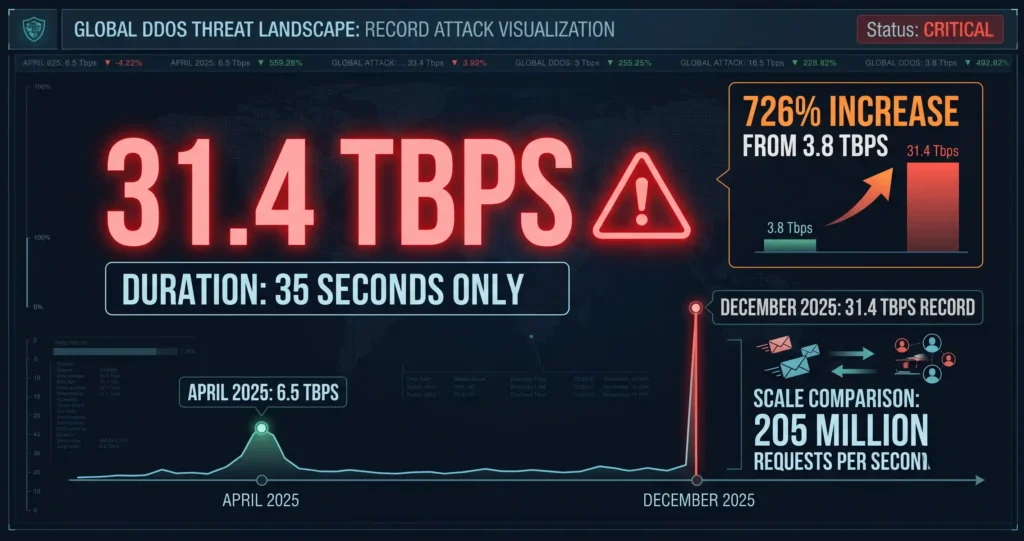
Cloudflare blocked 20.5 million DDoS attacks in Q1 2025 alone—96% of what the entire industry blocked in all of 2024. By year end 2025, 47.1 million DDoS attacks hit the global internet, representing 121% growth year-over-year. Attackers launched an average of 5,376 attacks every hour. One attack peaked at 31.4 Terabits per second (Tbps) and 14.1 billion packets per second, then vanished after 35 seconds. Network-layer attacks surged 509% year-over-year. HTTP/2 Rapid Reset attacks increased 3,488% in Q1 2025. Telecommunications became the most-attacked industry, followed by financial services, government, and e-commerce.
For Toronto businesses operating online, DDoS attacks aren’t theoretical threats anymore. They’re background radiation on the modern internet—persistent, evolving, and capable of disabling your business in minutes.
Understanding DDoS attacks isn’t just cybersecurity knowledge. It’s critical business protection. The question isn’t whether you’ll face a DDoS attack—it’s whether you’re prepared comprehensive DDoS protection and infrastructure defense when it happens.
What Is a Distributed Denial-of-Service (DDoS) Attack?
A DDoS attack is a malicious attempt to make an online service unavailable by overwhelming it with traffic from multiple sources simultaneously.
Unlike a Denial of Service (DoS) attack—which comes from a single computer—a DDoS attack uses thousands or millions of compromised devices coordinated to attack simultaneously. Think of it as directing a traffic jam at your website. Legitimate customers trying to reach your site get stuck behind overwhelming automated traffic that serves no purpose except to block access.
How DDoS Attacks Work
Step 1: Botnet Recruitment
Attackers build networks of compromised devices called “botnets.” These “zombie” devices include:
- Computers with malware infections
- Servers running vulnerable software
- IoT devices (smart TVs, security cameras, routers, printers)
- Smartphones with infected apps
- Legitimate cloud infrastructure rented by criminals
The Aisuru-Kimwolf botnet—responsible for the 31.4 Tbps record attack in December 2025—consisted of 1-4 million infected Android TVs primarily.
Step 2: Coordination and Activation
Attackers coordinate their botnet through command-and-control (C2) servers. At the attacker’s signal, millions of compromised devices simultaneously send requests to the target.
Step 3: Traffic Flood
The target receives overwhelming traffic:
- Legitimate requests mixed with bot requests become impossible to distinguish
- Infrastructure becomes exhausted
- Legitimate customers get dropped
- Services become inaccessible
The Three Types of DDoS Attacks
Volumetric Attacks
- Flood the target with massive traffic volume
- Attempt to consume all available bandwidth
- SYN floods are most common (sending thousands of connection requests)
- Measured in gigabits per second (Gbps) or terabits (Tbps)
- 2025 record: 31.4 Tbps (equivalent to 398 million Wikipedia article views per second)
Protocol Attacks
- Exploit weaknesses in network protocols
- CLDAP amplification surged 3,488% in Q1 2025
- Target network infrastructure directly
- Harder to detect than volumetric attacks
- Consume server resources without massive bandwidth
Application-Layer Attacks
- Target specific services with legitimate-looking requests
- HTTP/2 Rapid Reset exploits CVE-2023-44487—allows attackers to cancel stream requests at scale
- Appear like normal traffic but come from botnets
- Hardest to detect because they mimic legitimate use
- Rose 74% year-over-year in Q2 2025
When protecting website infrastructure and DDoS mitigation strategies, understanding attack types determines defense approach.
The Alarming 2025-2026 DDoS Landscape
DDoS has transformed from occasional nuisance to permanent internet feature.
Attack Volume Explosion
- 47.1 million attacks in 2025 (121% YoY increase)
- 20.5 million attacks in Q1 2025 alone
- 5,376 attacks per hour average throughout year
- 1.5 attacks per second globally
- Cloudflare mitigated 96% of their 2024 annual total in Q1 2025 alone
Record-Breaking Attack Sizes
Bandwidth Records:
- 31.4 Tbps attack in December 2025 (35 seconds duration)
- 6.5 Tbps attack in April 2025
- 4.8 Bpps (billion packets per second) on record
- 726% increase from 3.8 Tbps record just 14 months prior
Request Rate Records:
- 205 million requests per second observed
- 14.1 billion packets per second peak rate
- 6 million requests per second application-layer attacks (early 2025)
Hyper-Volumetric Attack Growth
Hyper-volumetric attacks (exceeding 1 Tbps, 1 Bpps, or 1 million requests per second):
- 700% growth compared with late 2024
- 700 attacks blocked in Q1 2025 alone
- 1,304 hyper-volumetric attacks in Q3 2025
- 40% growth from Q3 to Q4 2025
These aren’t rare edge cases anymore. Hyper-volumetric attacks are becoming routine.
Industry Targeting Patterns
Most Attacked Sectors (2025):
- Telecommunications: 28% of attacks
- Service providers and carriers
- IT services
- Gambling and gaming
- Software companies
- Financial services: 245% YoY surge in APAC region
- Government: rose from 5% to 12% of attacks YoY
Financial services experiencing 121% higher attack volume than 2021. This is where money flows—and where attackers follow.
The New Threat: AI-Powered DDoS and Botnets
Artificial intelligence has weaponized DDoS, making attacks easier, cheaper, and more effective.
AI-Assisted DDoS-as-a-Service
Attackers no longer need technical expertise. AI platforms like GhostGPT let attackers simply describe their target in plain language. The AI handles:
- Botnet selection
- Attack vector optimization
- Evasion of detection
- Timing and coordination
- Real-time adaptation
DDoS-for-hire services cost less than $1,000 for month-long attacks. Barriers to entry have essentially vanished.
The Aisuru-Kimwolf Botnet: A Case Study
The Aisuru-Kimwolf botnet dominated 2025 DDoS activity:
- 1-4 million infected Android TVs (consumer IoT devices)
- Responsible for 31.4 Tbps record attack
- Coordinated “The Night Before Christmas” campaign in December 2025
- Reached 205 million requests per second in sustained assaults
- Created hyper-volumetric attacks becoming daily incidents
This botnet demonstrates how consumer IoT devices—poorly secured smart TVs—become weapons in global-scale attacks.
Hacktivist DDoS Operations
Organized hacktivist groups conducting DDoS campaigns:
- NoName057(16): Pro-Russian collective targeting 50 unique hosts daily (peaking at 91), 3,700+ targets in 13 months
- Operation Eastwood (July 2025): Coordinated takedown across 12 countries by Eurojust and Europol—yet attackers returned with 80% more targets within weeks
- Crowd-sourced volunteer compute platforms distributing attacks globally
When implementing cybersecurity and threat monitoring strategies, understanding organized DDoS operations is critical.
The Real Cost of DDoS Attacks
DDoS isn’t just inconvenience. It translates directly into lost revenue, damaged reputation, and regulatory consequences.
Business Impact
Revenue Loss
- Every minute of downtime costs businesses thousands of dollars
- E-commerce sites lose direct sales during attacks
- SaaS platforms lose subscription revenue
- Services become unavailable to all customers
Reputation Damage
- Customers lose trust in service reliability
- Competitors gain market share while you’re offline
- Brand perception damaged by service unavailability
- Negative press coverage
Infrastructure Costs
- Unexpected surge in bandwidth consumption
- Emergency mitigation services required
- Team overtime handling incident response
- Forensic investigation to understand attack
Extortion and Ransomware Connection
DDoS increasingly used as extortion weapon:
- 9-19% of attacks financially motivated (extortion attempts)
- 16% of Cloudflare customers reported ransom DDoS attacks in Q1 2023 (60% YoY increase)
- DDoS + Data Breach: Attackers conduct DDoS for cover while exfiltrating data
- Financial services experiencing highest extortion targeting
When protecting business continuity and threat defense, understanding extortion tactics is essential.
DDoS Defense: What Actually Works
Defending against DDoS requires multi-layered approach. No single solution stops all attacks.
Defense Layer 1: Cloud-Based DDoS Mitigation
Providers like Cloudflare, Radware, and others offer:
- Global anycast networks absorbing attack traffic
- Automated detection triggering without human intervention
- Rate limiting blocking excessive traffic patterns
- Unmetered protection handling unlimited attack sizes
Cloudflare’s autonomous systems mitigated 80% of 2025 attacks without human intervention. This is the baseline defense for modern organizations.
Defense Layer 2: Rate Limiting and Behavioral Analysis
- Limit requests per IP per timeframe
- Flag unusual traffic patterns
- Analyze HTTP request characteristics
- Monitor for protocol anomalies
Limitation: Sophisticated bots and distributed attacks can bypass behavioral analysis.
Defense Layer 3: Geographic Traffic Filtering
- Route traffic through geographically distributed data centers
- Block traffic from unexpected regions
- Use anycast distribution spreading load
- Reduce single-point bottlenecks
Defense Layer 4: CAPTCHA and Verification
- Advanced CAPTCHAs distinguishing bots from humans
- Biometric verification for critical functions
- Device fingerprinting
- Risk-based authentication
Defense Layer 5: Infrastructure Redundancy
- Multiple data center locations
- Load balancing across geographic regions
- Backup internet providers
- Failover systems activating automatically
Defense Layer 6: Threat Intelligence and Response
- Real-time monitoring of attack patterns
- Information sharing with other organizations
- Rapid incident response procedures
- Post-attack forensics improving future defense
When implementing DDoS protection infrastructure and incident response, layered defense combining technology with strategy provides most effective protection.
Geographic and Organizational Diversity
DDoS attacks come from everywhere, making IP-based blocking ineffective.
Q4 2025 source distribution:
- Bangladesh: Largest source (Q4 2025)
- Ecuador: Second largest
- Indonesia: Third place
- Hong Kong: Jumped 12 places to #2 globally
- United Kingdom: Rose 36 places to #6
Most attacks originated from IP addresses associated with:
- DigitalOcean
- Microsoft cloud
- Tencent
- Oracle
- Hetzner
This highlights how attackers abuse cloud providers’ provisioning for attack infrastructure. Legitimate cloud services become weapons.
Toronto Business Protection Framework
For High-Target Industries
Financial Services, Telecommunications, E-Commerce:
- Cloud-based DDoS mitigation (non-negotiable)
- Incident response team with DDoS expertise
- Real-time threat monitoring
- Redundant infrastructure and failover systems
- Regular DDoS attack simulations
For Medium-Risk Businesses
SaaS, Media, Government Services:
- Cloud DDoS mitigation (essential baseline)
- Rate limiting and behavioral analysis
- Geographic traffic distribution
- Incident response procedures
- Regular monitoring and updates
For Smaller Organizations
Local Services, Nonprofits, Small E-Commerce:
- Basic cloud DDoS protection at minimum
- Rate limiting configurations
- ISP coordination for larger attacks
- Regular backups for critical data
- Incident communication plan
Conclusion: DDoS Is Now Permanent Internet Reality
47.1 million attacks in 2025. One attack every 0.6 seconds globally. Record 31.4 Tbps assaults lasting 35 seconds. This is the 2026 threat landscape.
DDoS attacks won’t decrease. They’ll intensify. AI is lowering attack barriers. Botnets grow larger. Attack sophistication increases. Attackers test new vectors constantly.
The question isn’t whether you’ll face a DDoS attack. It’s whether you’re prepared.
Organizations with cloud-based DDoS mitigation, incident response plans, and redundant infrastructure survive attacks with minimal impact. Organizations without these defenses experience catastrophic downtime, revenue loss, and reputation damage.
Toronto businesses competing in digital economy need DDoS defense as critical infrastructure investment—not optional security feature.
Ready to protect your business against DDoS attacks while maintaining legitimate traffic flow? Partner with experts who understand DDoS mitigation infrastructure and threat protection strategies that transform DDoS from existential threat into managed business reality.
About Byte Inspired: Based in Toronto, Byte Inspired helps businesses defend against evolving DDoS attacks threatening digital services. We understand DDoS in 2026 requires sophisticated cloud-based defense layers beyond simple rate limiting. Our comprehensive approach combines threat detection, incident response, and infrastructure protection to ensure Toronto businesses maintain service availability against record-breaking attacks. Discover how strategic DDoS defense protects your business continuity.
To visit our social media, please click on Facebook and Instagram